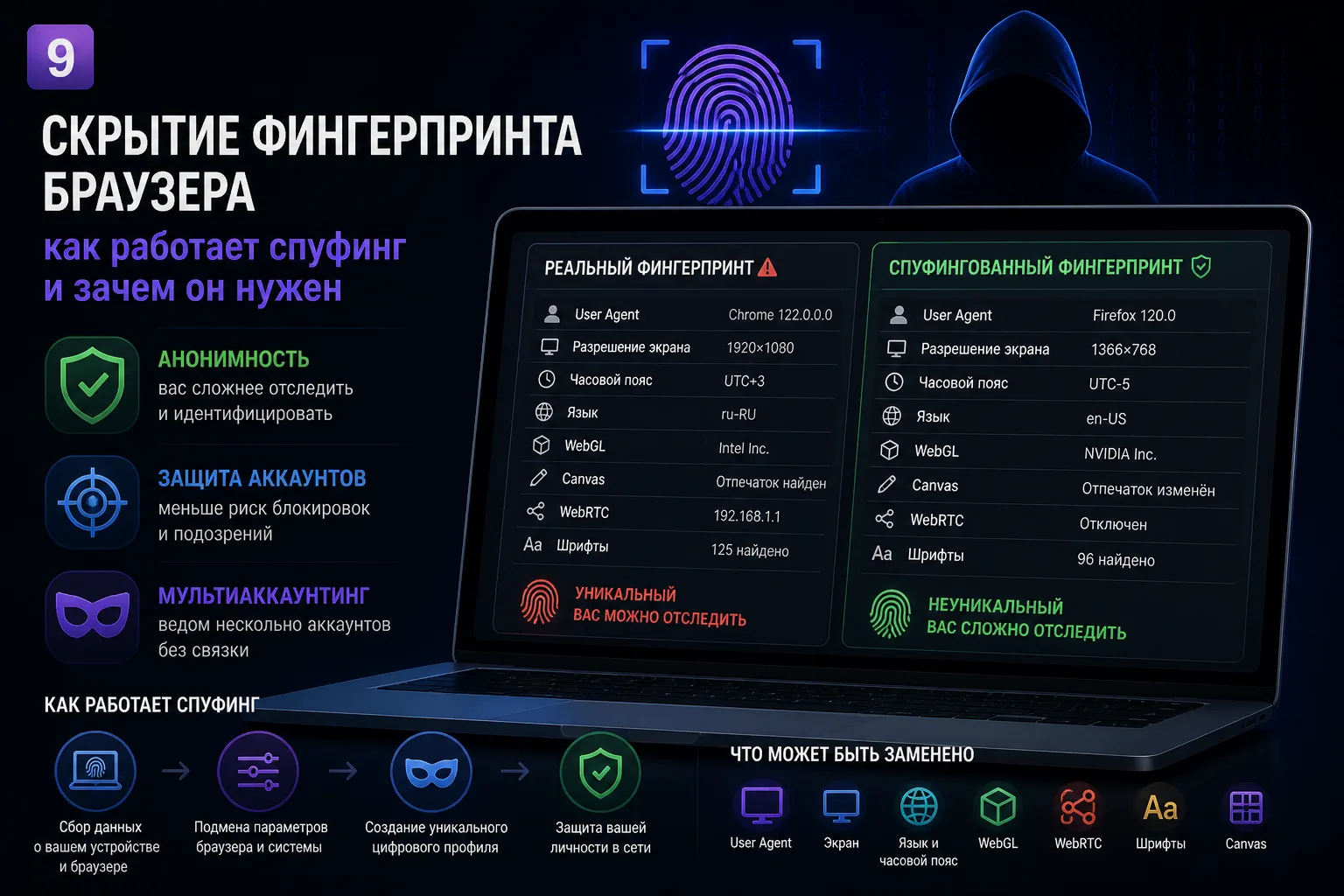
The Science of Browser Fingerprinting
Browser fingerprinting is a technique that identifies users based on the unique characteristics of their browser and device configuration. Unlike cookies, fingerprints are passive — they can't be deleted — and they work even in private browsing mode. Understanding how fingerprinting works is essential for anyone working with antidetect browsers.
Canvas Fingerprinting
Canvas fingerprinting works by drawing an invisible image or text using the HTML5 Canvas API. Due to differences in GPU hardware, drivers, operating systems, and rendering engines, the same drawing operation produces slightly different pixel values on different machines. These differences create a unique hash that identifies the device.
Antidetect browsers spoof canvas fingerprints by adding a tiny, imperceptible amount of noise to the canvas output — enough to change the hash while keeping the image visually identical to a human observer.
WebGL Fingerprinting
WebGL is used for 3D rendering in browsers. It exposes the exact GPU model (vendor + renderer), driver version, and rendering capabilities. These parameters are highly unique and very difficult to spoof realistically.
Quality antidetect browsers use real GPU parameter sets from actual device databases, ensuring the spoofed WebGL data appears legitimate rather than obviously fake.
AudioContext Fingerprinting
The Web Audio API processes audio differently on different hardware configurations. Small numerical differences in audio processing — the AudioContext fingerprint — uniquely identify devices across sessions.
Antidetect browsers modify AudioContext output with controlled noise, similar to canvas spoofing.
Other Fingerprint Vectors
- Fonts: The list of installed fonts varies significantly between systems
- Plugins and extensions: Visible to websites and create identifiable patterns
- Screen resolution and color depth: Combined with other data, narrows down user identity
- Hardware concurrency: Number of logical CPU cores
- Battery status: Battery level and charging state (where available)
- Network information: Connection type and effective bandwidth
Why Antidetect Browsers Are Better Than Extensions
Browser extensions can block or randomize some fingerprint vectors, but they have significant limitations:
- Extensions are themselves visible to websites (creating an identifiable pattern)
- Inconsistent spoofing (blocking some vectors but not others) looks suspicious
- Extensions can't fully control low-level browser APIs
Antidetect browsers modify fingerprints at the core browser level, ensuring all vectors are consistently spoofed as a coherent, realistic identity.